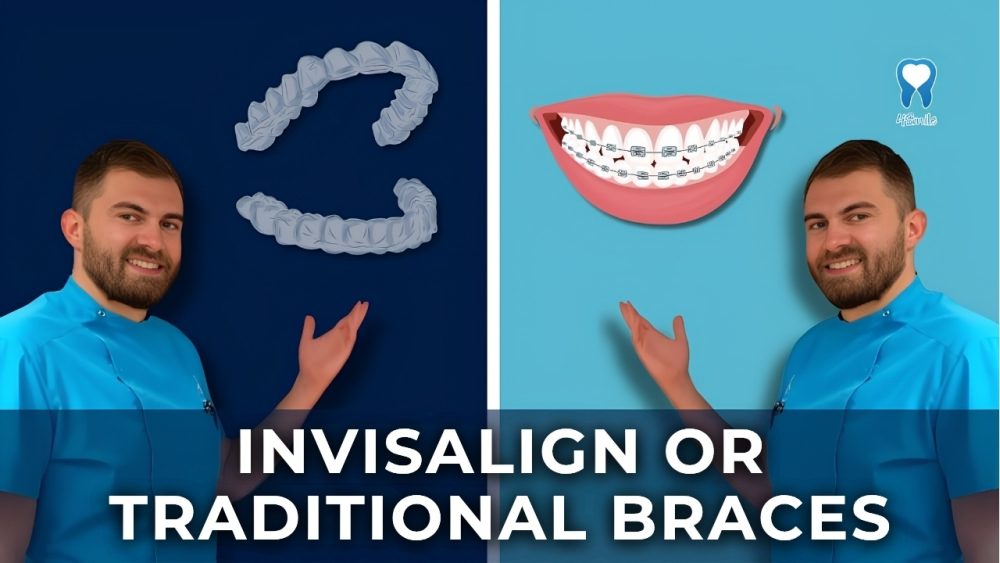
Invisalign or traditional braces
Invisalign or traditional braces: The key differences
Choosing orthodontic treatment is no longer as straightforward as it once was. More and more patients ask the same question:
Invisalign or traditional braces; which is better, and which one actually works?
The answer isn’t universal. It depends on your specific case, your lifestyle, and your treatment goals. Below, we explain the key differences in a clear, professional, and realistic way to help you make an informed decision.
What is Invisalign, and when is it the best choice?
Invisalign is a system of clear, removable aligners that gradually move your teeth into their desired position. Because they are virtually invisible, they have become especially popular among adult patients.
Advantages of Invisalign
- Aesthetics: Almost invisible while wearing them.
- Oral hygiene: Easily removable, allowing thorough brushing and flossing.
- Comfort: No wires or brackets that can irritate the inside of your mouth.
Disadvantages of Invisalign
- Discipline required: Aligners must be worn for at least 22 hours a day.
- Patient compliance: Results depend directly on how consistently you wear them.
- Not suitable for every case: Complex tooth movements may require a different treatment approach.
Conclusion: Invisalign is an excellent option for motivated and disciplined patients who want a discreet orthodontic solution.
Traditional braces: A proven solution for a reason
Traditional fixed braces remain the gold standard in orthodontics, especially for more complex treatments.
Advantages of traditional braces
- Greater control: Your orthodontist has complete control over tooth movement.
- Highly effective: Ideal for complex cases and significant root movement.
- Consistent treatment: Since they are fixed in place, you can’t forget to wear
Disadvantages
- Aesthetics: More noticeable than Invisalign.
- Oral hygiene: Require extra care and proper cleaning techniques.
- Comfort: Some initial irritation is common after placement or adjustments.
Conclusion: Traditional braces are the more reliable choice for demanding orthodontic treatments.
Which one actually works better?
Here’s the most important truth that patients often overlook:
There is no universally “better” orthodontic appliance – only the treatment that’s better suited to your individual case.
In practice, this means:
- If your case is relatively straightforward and you’re committed to wearing your aligners consistently, Invisalign may be the ideal solution.
- If your treatment is more complex or there’s a risk of inconsistent compliance, traditional braces are often the safer and more predictable choice.
Expert recommendation from Dental Center 4Smile
At Dental Center 4Smile, every patient receives an individualized treatment plan.
Based on a comprehensive examination, bite analysis, and an understanding of your lifestyle, we recommend the orthodontic solution that will provide:
- the fastest path to the best possible results,
- maximum functionality,
- long-term stability of your smile.
The decision isn’t purely aesthetic – it’s both a medical and strategic one.
Whether you’re considering Invisalign or traditional braces, one thing remains essential:
The goal isn’t just a straighter smile – the goal is the highest-quality, long-lasting result.
If you could choose without any limitations, which orthodontic treatment would you wear, and why?
Author: Ivan Antolković, DMD, Univ. Mag. Med. Dent.
Dental Center 4Smile