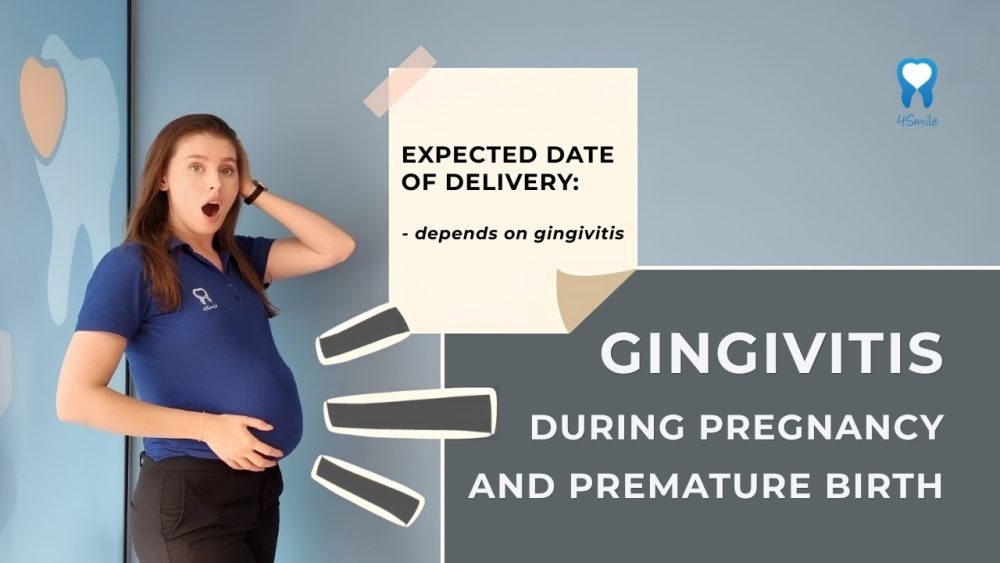
Healthy habits you should practice during pregnancy, such as eating a healthy diet, exercising regularly, and taking supplements, are probably already familiar to you.
However, you may not be aware of the consequences of poor oral health during pregnancy.
Did you know that gingivitis can lead to premature birth?
In this week’s blog from Dental Center 4Smile, read about how and why gingivitis can lead to premature birth and how you can prevent it.
Some studies have found that pregnant women with chronic gum disease (gingivitis and periodontitis) are 4 to 7 times more likely to give birth prematurely!
Research has also shown that as many as 45% of women who experienced premature birth were 1.5 times more likely to have gum disease.
But pregnant women are not the only ones at risk.
Prematurely born babies are at greater risk of health problems such as infections, asthma, and feeding difficulties.
There is also a greater risk of sudden infant death syndrome (SIDS), meaning that babies have a higher chance of dying within the first month of life.
The connection between gum inflammation and pregnancy
As we know, gum inflammation is caused by bacteria.
However, the bacteria responsible for gum inflammation can also enter the placenta through the bloodstream, causing inflammation.
The fetus is surrounded by the amniotic sac, which can rupture due to bacteria entering the placenta.
Premature rupture of the amniotic sac results in premature birth.
Did you know that according to some studies, as many as 70% of women develop gingivitis during pregnancy – pregnancy gingivitis?
During pregnancy, progesterone levels are elevated, leading to an increased risk of dental plaque buildup and gum disease.
Bleeding gums during pregnancy are common, but not normal – they are a warning sign of certain health problems.
The symptoms of gingivitis include bleeding gums, swollen gums, red gums, bad breath, receding gums, and loose teeth.
Unfortunately, pregnant women often ignore these oral health problems because they are unaware of the consequences of gum inflammation during pregnancy.
However, if gingivitis is left untreated in pregnant women, it can cause very serious problems.
Symptoms of gingivitis and periodontitis
Gingivitis and periodontitis are two types of gum disease that differ from one another.
Gingivitis is a mild form of gum disease characterized by swollen, bleeding, and bright red gums.
Periodontitis, on the other hand, is a severe gum infection that destroys the structures supporting the teeth.
If gingivitis is not treated, it can progress to periodontitis.
If you have periodontitis, you may notice pus discharge from the gums as well as loose teeth.
It is important that as soon as you notice any symptoms, you contact your dentist, Ivan Antolković, and schedule an examination at Dental Center 4Smile.
Prevention of gingivitis
Gingivitis can be prevented by following some simple preventive measures.
Preventive measures recommended by dentist Ivan Antolković include:
Regular dental checkups
As soon as you find out that you are pregnant, visit your dentist, Ivan Antolković, so that he can professionally assess the condition of your gums.
Every pregnant woman should visit her dentist during the first or early second trimester.
Your dentist, Ivan Antolković, will diagnose any gum problems even in their early stages. If gum problems are detected, they can be treated early with simple procedures such as scaling and root planing and tartar removal.
It is also important to know that these treatments are completely safe for pregnant women.
Of all dental procedures and treatments, only frequent X-rays are generally not recommended.
Maintaining oral hygiene
You should brush your teeth at least twice a day using the proper brushing technique.
The use of a dental water flosser is also highly recommended.
If you are unable to obtain a dental water flosser, you should use dental floss to clean hard-to-reach areas between your teeth.
This will help prevent excessive plaque buildup between the teeth.
After meals, it is also advisable to use a mouthwash for additional protection of your teeth.
Treat gingivitis early
As mentioned earlier, untreated gingivitis can become more complicated and lead to periodontitis.
In the early stages of gum disease, only simple dental procedures are needed.
However, if gum disease progresses to severe forms, surgery may be required.
Therefore, it is certainly better to react immediately!
Using a soft-bristled toothbrush
Dentist Ivan Antolković generally recommends using a toothbrush with soft bristles, and this is especially important for pregnant women.
Using a soft toothbrush will clean your teeth effectively while also preventing gum injuries.
Gum injuries can also cause gum inflammation, so they should definitely be avoided.
Proper toothbrushing technique
To prevent food or plaque from getting trapped between the teeth and gums, proper toothbrushing technique is necessary.
Dentist Ivan Antolković recommends the following brushing method:
- Hold the toothbrush at a 45-degree angle to the gum line.
- Brush every surface of every tooth (front surfaces, tongue or palatal surfaces, and chewing surfaces).
- Brush using short circular motions, moving from the gums toward the tooth.
- Use your non-dominant hand to help avoid applying excessive force.
Proper nutrition
It is well known that nutrition greatly affects overall body health, including dental health.
By the sixth week of pregnancy, the foundations for all of the baby’s primary teeth are formed, which is one reason why proper nutrition is important for both the baby and the mother.
It is recommended that you consume a balanced diet rich in vitamins, since vitamin deficiency can also cause bleeding gums.
Vitamins are most commonly found in fresh fruits and vegetables.
Fresh fruits and vegetables are also rich in fiber, which further promotes gum health.
Additionally, consuming milk and dairy products during pregnancy is very important because of calcium intake.
Calcium is important for the development of the skeletal system as well as the development of teeth.
The incorporation of calcium into bones and teeth begins after the fifth month of pregnancy.
For a safe pregnancy, you must maintain good oral health along with all other measures such as proper nutrition and exercise.
Regular toothbrushing twice a day and frequent mouth rinsing are excellent preventive measures for maintaining oral hygiene.
Still, the best and unavoidable preventive measure should be regular visits to the dentist.
If you are pregnant or planning a pregnancy, come for an examination at Dental Center 4Smile.
Your dentist, Ivan Antolković, will use timely diagnosis to eliminate possible oral health problems that could harm you and your baby during pregnancy.
In addition, he will provide you with all the necessary advice and guidelines regarding dental care during pregnancy.