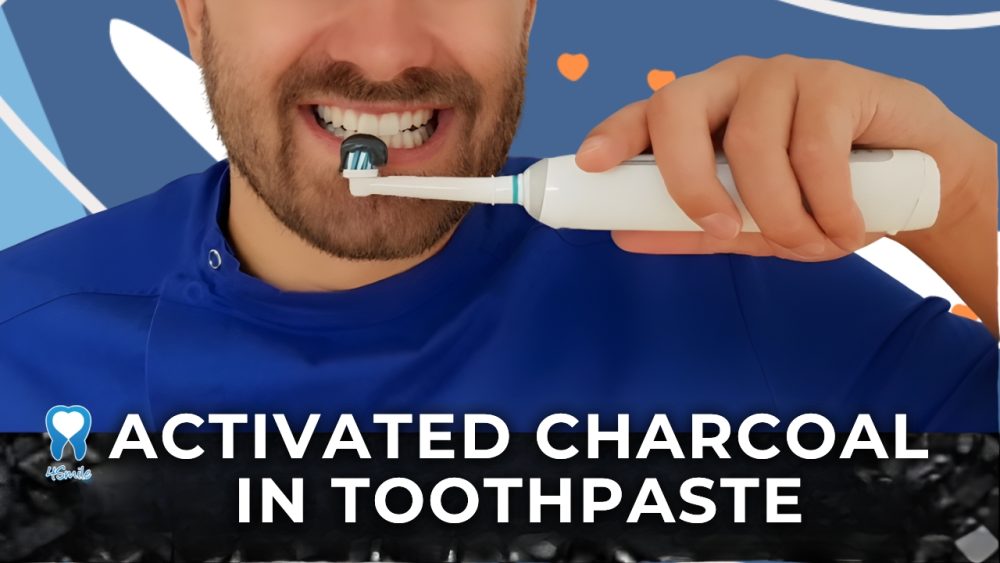
Fans of activated charcoal toothpaste claim it whitens teeth and freshens breath better than any other toothpaste. Nowadays, activated charcoal is a major trend and can be found in everything (in the form of dietary supplement tablets, face masks, toothpaste…). However, new research has questioned whether activated charcoal actually does more harm than good when it comes to your teeth.
In this week’s Dental Center 4Smile blog, read everything you need to know about the activated charcoal toothpaste trend.
What is activated charcoal?
Activated charcoal, commonly found in water filters, is essentially a form of carbon processed so that the surface of its particles becomes porous. These tiny particles then act like magnets to other particles (such as dirt and oil), absorbing them and allowing unwanted substances to be removed when the charcoal is rinsed away.
Charcoal is so powerful that it is commonly used in hospitals and emergency services to treat patients suffering from poisoning or drug overdose.
What do scientific studies say about activated charcoal in toothpaste?
“A review in the British Dental Journal from early 2019 found that activated charcoal provided weak protection against tooth decay, and there is no other scientific evidence supporting other health claims. In reality, adding powdered charcoal to toothpaste can actually make things worse. – If used on people with composite fillings, charcoal can get into them and is difficult to remove -,” said Dr. Joseph Greenwall-Cohen, research associate at the University of Manchester’s Dental School, for the BBC. “ – Charcoal particles can also get into the gums and irritate them – .”
There is concern about the abrasive properties of activated charcoal, which some say could damage enamel if used regularly, as well as activated charcoal’s tendency to absorb any substances it comes into contact with, including beneficial substances like medications. Others claim that activated charcoal is not particularly harmful to teeth, it simply will not have any positive long-term effect on your smile because the active ingredient does not remain in contact with the tooth surface long enough to create a significant whitening effect.
“Activated charcoal may be used as a supplement to brushing with regular toothpaste for those seeking a whiter smile, but not as a replacement for regular toothpaste,” says Lituchy. “Regular toothpaste gives us the fluoride we need to fight tooth decay, and it must remain a part of the daily routine.”
How effective is tooth whitening with activated charcoal?
There is a difference between removing surface stains and whitening. Surface stains, also known as extrinsic stains, come from common culprits: coffee, red wine, tobacco, and dark-colored foods and drinks. They are located on the outer enamel layer and can usually be removed with toothpaste, professional dental cleaning, or surface whitening treatments.
Deeper, intrinsic stains are discolorations that come from within the tooth, sometimes as a result of trauma, weak enamel, certain types of medication, or even excessive use of fluoride. Think of it as the underlying color of the tooth; no matter how dedicated you are to whitening the surface, significant brightening of tooth color can only come from whitening treatments that penetrate below the outer surface of the tooth.
Dentist Ivan Antolković on whitening teeth with activated charcoal toothpaste:
“Activated charcoal in toothpaste can help remove surface stains on teeth. Charcoal is mildly abrasive and can also absorb surface stains to a certain extent.
There is no evidence, however, that it has any effect on stains beneath the enamel, or that it has a natural whitening effect.
To whiten teeth, a product must be effective on both surface stains and intrinsic stains, the ones beneath the enamel.
Although activated charcoal has some proven benefits, there is not enough scientific evidence to consider tooth whitening one of them.”
Dentist in Zagreb, Ivan Antolković, also emphasized that although using an abrasive agent such as activated charcoal to remove surface stains may make teeth appear whiter, in the long run they may actually become darker. “Because of the abrasive effect, activated charcoal thins the enamel and the inner dentin, which is darker than enamel, becomes increasingly visible.”
The potentially harmful effects of activated charcoal do not stop at the enamel. Dr. Antolković stresses that loss of enamel can lead to increased tooth sensitivity and consequently tooth decay.
For whitening, Dr. Antolković recommends peroxide-based products: “Hydrogen peroxide derivatives have proven to be the safest and best for teeth whitening through long-term research. We know they are safe, and we know they work.”
“The best method of teeth whitening is professional whitening,” states Dr. Antolković, explaining that whitening at the dental office in Zagreb’s Dental Center 4Smile typically lasts about an hour to an hour and a half and delivers immediate results.
Does activated charcoal really have a detoxifying effect on the oral cavity?
Regarding claims of “detoxifying” the mouth, while activated charcoal can remove plaque and food particles that lead to bad breath, the effect will be no better than any other toothpaste. Unlike the liver and kidneys, teeth and gums do not perform the body’s detoxification function, and since so-called “toxins” do not remain in the mouth anyway, detox claims “fall flat.”
Here’s what we know so far about activated charcoal toothpaste:
Activated charcoal toothpaste is too abrasive for daily use. Daily use can damage your enamel. This may make teeth appear yellow, as dentin—a yellow calcified tissue-becomes exposed. It can also make your teeth more sensitive.
Most charcoal toothpaste brands do not contain fluoride. Fluoride helps maintain strong tooth enamel, which protects against cavities and decay.
It may cause staining on certain teeth. Charcoal particles can accumulate in cracks in the teeth.
The effect of activated charcoal on dental prosthetics is unknown. It is not yet known how activated charcoal affects the materials used for dental veneers, bridges, crowns, and white fillings. Charcoal particles may accumulate between them, leaving a black or gray outline.
To date, the only known benefits of charcoal toothpaste:
- It can help remove surface stains on teeth.
- It can improve bad breath.
- If used occasionally after professional cleaning, it may help prevent stain buildup.
Although activated charcoal toothpaste attracts a lot of attention and is currently trendy, as we have emphasized, there are far more effective and safer options for whitening teeth.